Can Bleach Hair Grow Black Again
Grayness Hair Tin can Return to Its Original Color—and Stress Is Involved, of Grade
The universal marking of aging is not always a one-fashion process
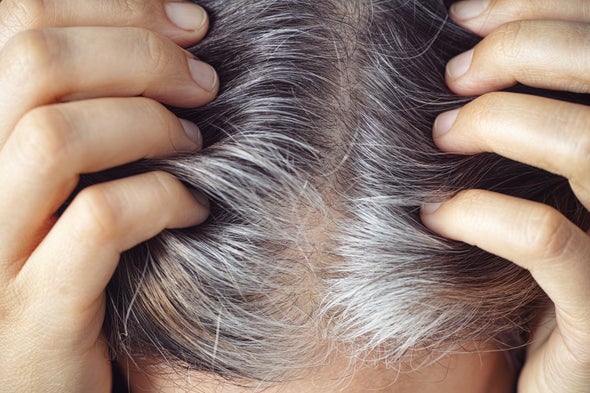
Few harbingers of old age are clearer than the sight of gray hair. Equally nosotros grow older, black, brownish, blonde or cherry strands lose their youthful hue. Although this may seem similar a permanent modify, new inquiry reveals that the graying process can be undone—at to the lowest degree temporarily.
Hints that gray hairs could spontaneously regain color have existed every bit isolated example studies within the scientific literature for decades. In one 1972 paper, the belatedly dermatologist Stanley Comaish reported an encounter with a 38-yr-old homo who had what he described as a "almost unusual feature." Although the vast bulk of the individual'due south hairs were either all black or all white, 3 strands were light nigh the ends just dark almost the roots. This signaled a reversal in the normal graying process, which begins at the root.
In a study published today in eLife, a group of researchers provide the virtually robust evidence of this phenomenon to engagement in hair from around a dozen people of various ages, ethnicities and sexes. It also aligns patterns of graying and reversal to periods of stress, which implies that this aging-related process is closely associated with our psychological well-being.
These findings suggest "that there is a window of opportunity during which graying is probably much more reversible than had been thought for a long time," says study co-author Ralf Paus, a dermatologist at the University of Miami.
Around four years ago Martin Picard, a mitochondrial psychobiologist at Columbia University, was pondering the manner our cells grow old in a multistep manner in which some of them begin to show signs of aging at much earlier fourth dimension points than others. This patchwork process, he realized, was conspicuously visible on our caput, where our hairs do non all plow greyness at the same fourth dimension. "It seemed like the hair, in a way, recapitulated what nosotros know happens at the cellular level," Picard says. "Maybe there's something to acquire in that location. Maybe the hairs that turn white first are the more vulnerable or least resilient."
While discussing these ideas with his partner, Picard mentioned something in passing: if ane could find a hair that was just partially gray—and then calculate how fast that hair was growing—it might be possible to pinpoint the menses in which the hair began aging and thus ask the question of what happened in the individual's life to trigger this change. "I was thinking almost this almost as a fictive idea," Picard recalls. Unexpectedly, however, his partner turned to him and said she had seen such two-colored hairs on her head. "She went to the bathroom and actually plucked a couple—that's when this project started," he says.
Picard and his team began searching for others with two-colored hairs through local ads, on social media and by discussion of mouth. Eventually, they were able to detect 14 people—men and women ranging from ix to 65 years old with various indigenous backgrounds (although the majority were white). Those individuals provided both single- and 2-colored hair strands from unlike parts of the body, including the scalp, confront and pubic expanse.
The researchers and so developed a technique to digitize and quantify the subtle changes in color, which they dubbed hair pigmentation patterns, along each strand. These patterns revealed something surprising: In 10 of these participants, who were betwixt historic period ix and 39, some graying hairs regained color. The team also found that this occurred non merely on the head but in other bodily regions as well. "When we saw this in pubic pilus, we thought, 'Okay, this is real,'" Picard says. "This happens not just in one person or on the caput but across the whole body." He adds that considering the reversibility but appeared in some hair follicles, however, it is likely limited to specific periods when changes are withal able to occur.
Most people beginning noticing their first greyness hairs in their 30s—although some may find them in their late 20s.This period, when graying has simply begun, is probably when the process is most reversible, according to Paus. In those with a full head of gray pilus, nearly of the strands accept presumably reached a "point of no return," just the possibility remains that some hair follicles may however exist malleable to change, he says.
"What was most remarkable was the fact that they were able to testify convincingly that, at the individual hair level, graying is really reversible," says Matt Kaeberlein, a biogerontologist at the University of Washington, who was one of the editors of the new paper simply was not involved in the piece of work. "What we're learning is that, not only in pilus only in a variety of tissues, the biological changes that happen with age are, in many cases, reversible—this is a nice example of that."
The team likewise investigated the association betwixt hair graying and psychological stress considering prior research hinted that such factors may advance the hair'south aging process. Anecdotes of such a connection are besides visible throughout history: according to fable, the hair of Marie Antoinette, the 18th-century queen of France, turned white overnight just earlier her execution at the guillotine.
In a small subset of participants, the researchers pinpointed segments in unmarried hairs where color changes occurred in the pigmentation patterns. Then they calculated the times when the change happened using the known average growth rate of human pilus: approximately i centimeter per month. These participants as well provided a history of the most stressful events they had experienced over the course of a year.
This assay revealed that the times when graying or reversal occurred corresponded to periods of significant stress or relaxation. In one individual, a 35-year-old man with auburn hair, 5 strands of pilus underwent graying reversal during the same fourth dimension span, which coincided with a ii-calendar week holiday. Another subject, a 30-year-quondam adult female with black pilus, had one strand that contained a white segment that corresponded to two months during which she underwent marital separation and relocation—her highest-stress menstruum in the twelvemonth.
Eva Peters, a psychoneuroimmunologist at the University Hospital of Giessen and Marburg in Germany, who was not involved in this work, says that this is a "very creative and well-conceptualized study." But, she adds, considering the number of cases the researchers were able to await at was relatively minor—particularly in the stress-related portion of the study—further research is needed to confirm these findings.
For now, the next step is to look more carefully at the link between stress and graying. Picard, Paus and their colleagues are currently putting together a grant to conduct another study that would examine changes in hair and stress levels prospectively—which means tracking participants over a specified period of time rather than asking them to retrieve life events from the past.
Eventually, Picard says, one could envision pilus as a powerful tool to assess the furnishings of before life events on aging—because, much like the rings of a tree, hair provides a kind of physical tape of elapsed events. "It'southward pretty articulate that the hair encodes part of your biological history in some way," he says. "Hair grows out of the body, and then it crystallizes into this hard, stable [structure] that holds the memory of your by."
Nigh THE AUTHOR(S)

Source: https://www.scientificamerican.com/article/gray-hair-can-return-to-its-original-color-mdash-and-stress-is-involved-of-course/

Post a Comment for "Can Bleach Hair Grow Black Again"